Conservation and laboratory · HEXPEPS GUIDE
Concentration calculator: mg, µg and mL
This tool relates a nominal amount of sample to the final volume of a solution. It is used to review laboratory units; it does not decide a dose, frequency or volume of administration.
FAST RESPONSE
How is a concentration in mg/mL calculated?
Divide the mass in mg by the final volume in mL. It is a nominal concentration: it does not verify the contents of the vial and does not determine a dose, route or frequency of administration.
 Editorial illustration · Hexpeps
LABORATORY TOOL
Calculate the nominal concentration
Enter data for a sample and its final volume. The tool does not recommend preparations or guidelines.
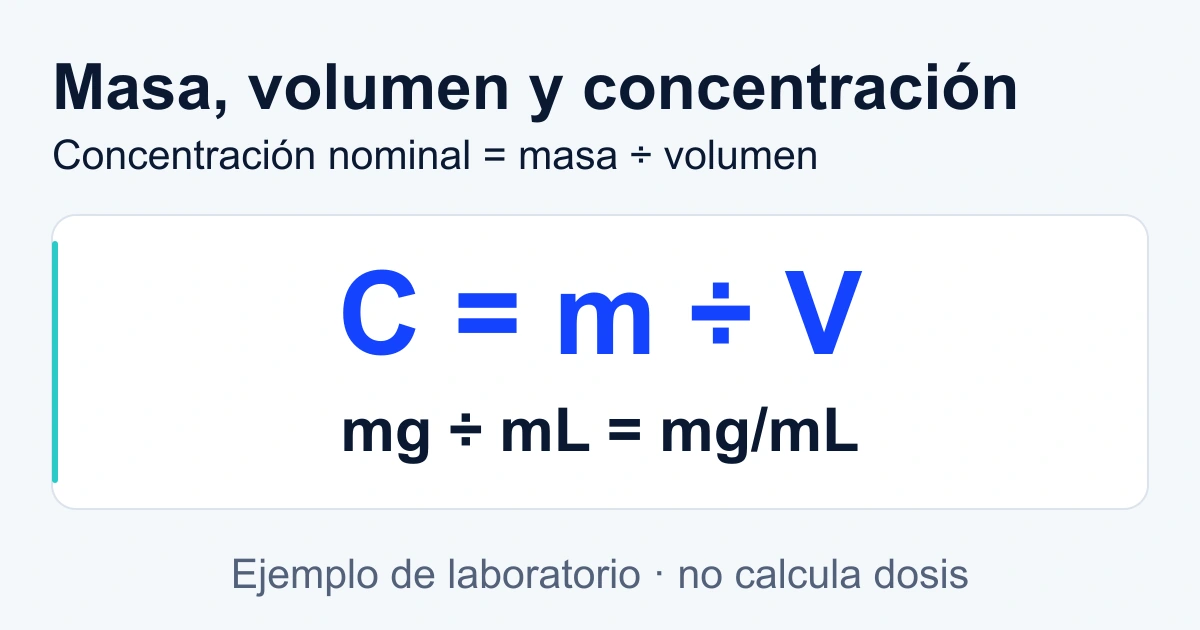
C = mass ÷ final volume. It does not correct analytical content, humidity or counterions. It does not calculate doses or administration volumes.
The formula: mass divided by volume
Mass concentration expresses how much sample there is per unit volume. If the mass is entered in milligrams and the final volume in milliliters, the result is expressed in mg/mL. To convert to µg/mL, multiply by 1,000.
Use the final volume of the solution. Added volume and final volume should not be treated as equivalent if the procedure or measurement indicates otherwise.
An example of units, not a guideline
As an abstract example, 4 mg of a laboratory sample in a final volume of 8 mL produces a nominal concentration of 0.5 mg/mL, equivalent to 500 µg/mL. It is an arithmetic operation; does not recommend this preparation for any product in the catalog.
If you double the volume while maintaining the same mass, the concentration is reduced by half. If you want to know an amount in a laboratory aliquot, the calculation uses the concentration and volume of that aliquot; Always follow the test design.
What does “nominal” mean?
The tool uses the dough you enter, without verifying or correcting it. Does not automatically apply HPLC purity, peptide content, humidity or counterions. If the test requires net mass, you must have an adequate analytical basis and make the correction according to the protocol.
Bachem distinguishes purity and peptide content when calculating solutions. Knowing that difference avoids converting a chromatographic percentage into a quantity that the report has not measured.
Why concentration does not mean dose
A concentration does not establish whether a substance is suitable for human use. Nor does it determine an indication, a safe amount, a frequency or a route of administration.
Therefore, this calculator does not have syringe brands, insulin units, body weight or recommendations for use. Questions about treatments should be resolved with authorized health professionals and medications.
mg, µg, mL and mg/mL: they are not interchangeable
mg and µg express mass; mL expresses volume; mg/mL expresses mass per unit volume. To go from mg to µg, multiply by 1,000. To obtain mg/mL, divide by the final volume, maintaining units in each step.
Didactic example of a laboratory sample: 6 mg in a final volume of 3 mL gives 2 mg/mL, equivalent to 2,000 µg/mL. Doubling the final volume to 6 mL gives 1 mg/mL; the total nominal mass remains 6 mg. The example does not refer to a preparation to be administered.
| Data | What does it represent? |
|---|---|
| Nominal mass | Amount entered, pending analytical verification |
| Final volume | Volume of the solution already prepared |
| mg/mL | Nominal mass per mL |
| µg/mL | The same concentration expressed in another unit |
A mixture has a concentration per component
Fictitious case for a trial: a preparation declares 3 mg of A and 2 mg of B in 5 mL final. The nominal concentration of A is 0.6 mg/mL and that of B is 0.4 mg/mL. The sum of masses is 5 mg; does not mean 5 mg of each compound.
The calculator receives a single mass. In a mixture, use it separately for each component whose quantity is specified, maintaining the same final volume. If the label only reports the total, one piece of information is missing to obtain the individual concentrations.
Frequently asked questions
How many micrograms are in a milligram?
1 mg is equivalent to 1,000 µg. Keep units visible during calculation.
Does the tool calculate doses of retatrutide, GHK-Cu or BPC-157?
No. Calculate only a nominal concentration by mass. It does not verify the material or establish administration guidelines.
Do added volume and final volume mean the same thing?
They are different concepts. The formula uses final volume of solution. Record the basis required by the trial protocol.
mg and mL convert directly?
No. To relate mass and volume you need the concentration and identity of the preparation; They are units of different magnitudes.
Sources consulted
References consulted for this guide. They do not constitute certificates of Hexpeps products or endorsements of our store.
Conversations that help identify these doubts
Origin of questions, not medical evidence or seller verification. The full selection and its limits are explained in our editorial criteria.
Editorial content on laboratory concepts and documentation. It does not replace health advice nor does it establish guidelines for human or animal use.
Consult formats, prices and documentation
In each file you can choose the presentation, consult its published COA and prepare your order online.
Choose product and format →Do you want to collaborate with Hexpeps? Discover our affiliate program. Affiliate program